OIL OUTLOOK / SCS RESEARCH
Oil toward $119–$120? What our outlook could mean for shipping costs
A July weekly signal underpins a bullish crude-oil scenario into early January 2027. For shippers, the practical question is how diesel, jet fuel and bunker costs would reach their actual invoices.
SCS Research: proprietary channel-based outlook with separately sourced freight-cost scenario analysis. The model has not been independently reproduced or backtested for this review.
RESEARCH DRAFT · NOT ISSUED · NOT SCOREDTHE OUTLOOK. THE EXPOSURE.
Our proprietary channel-based model indicates a bullish CL1! scenario toward $119–$120 per barrel in early January 2027, subject to the current invalidation: a bearish weekly candle closing strictly below $86.86. This is a conditional thesis, not an independently verified model result. If that crude scenario lifts refined-fuel costs, shipping fuel charges could rise. The size and timing depend on the fuel benchmark, carrier agreement and shipment profile; no percentage increase in freight costs can be inferred directly from the crude target.
THE THESIS AT A GLANCE
- Benchmark
- CL1! continuous Light Crude Oil Futures; USD per barrel; weekly chart. Chart exchange/feed and adjustment settings unconfirmed.
- Reported signal
- Week beginning July 6, 2026. The exact confirming weekly-close date is not established.
- Reported setup
- Reported bullish weekly close $71.41 above bearish candle open $70.50, with stochastic at lows; not independently reproduced.
- Target zone
- $119–$120 per barrel, approximately early January 2027. Exact deadline convention and touch-versus-close test remain open.
- Current invalidation
- A bearish weekly candle CLOSE strictly below $86.86, supplied October 26 PDT. Not an intraday touch or an equal close.
- Record timing
- Retrospective July signal; first documented by SCS October 26, 2026 PDT. This draft does not establish an independently archived July forecast.
View the research chart and its limitations
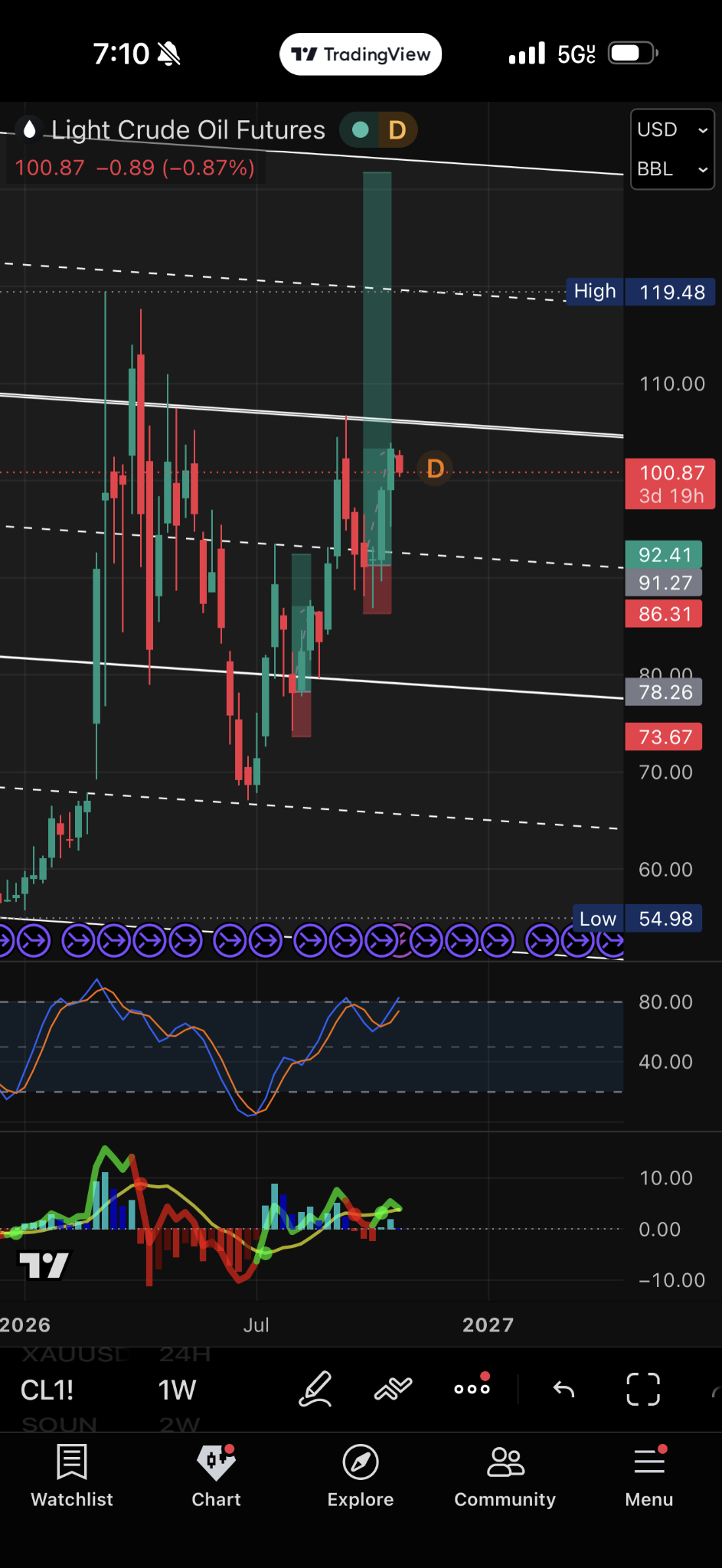
The thesis: a July reversal with an unfinished channel target
Our proprietary channel-based model indicates a bullish setup associated with the week beginning July 6, 2026. The reported setup is a bullish weekly candle closing at $71.41, above a bearish candle’s $70.50 open, near the reported $68–$70 low area, with stochastic readings at lows. These supplied model observations and their interpretation have not been independently reproduced for this review.
The target comes from our proprietary channel-based analysis. Under this thesis, the March/April high at $119.48 did not reach the channel’s midline before retracing, leaving an unfinished upside objective. The scenario therefore anticipates another advance toward roughly $119–$120, with a gradual rise as the expected path. Pullbacks, faster moves, a failed thesis or a missed time window remain possible.
The six-month clock starts with the July signal, not with this October write-up. The appropriate approximate horizon is early January 2027, not April 2027. Monday July 6 identifies the start of the stated week; it is not being presented as the timestamp of a completed weekly candle.
Historical accuracy claims have not been independently verified. No independent backtest, event definitions or archived forecast sample has been supplied for this review. This article does not assign a validated probability to the target or reproduce proprietary implementation details.
This section records a supplied research interpretation. It does not execute an automated price-prediction algorithm or connect to a live market-data feed.
What would change the outlook?
Our current invalidation requires both conditions: the candle must be bearish, and its weekly close must be strictly below $86.86. An intraday move below that level, or a weekly close exactly at it, does not meet the rule as stated. A qualifying close would invalidate the current bullish thesis under the stated rule and require a dated reassessment.
This threshold was supplied in the October 26 PDT update. It must not be retroactively treated as the original July threshold, especially because the reported July low area was below $86.86. The supplied analysis links the level to a recent low about three weeks earlier; that relative dating has not been independently confirmed.
A target-zone encounter would also require review, but a successful outcome cannot yet be scored: the model specification does not yet establish whether success requires a touch or a weekly close, or the precise six-month deadline convention. A rise arriving outside the eventual agreed window would not automatically validate a time-bounded call. Future changes to target, timing or invalidation should be recorded as new revisions rather than silently rewriting this edition.
What the chart establishes, and what it does not
The submitted TradingView screenshot visibly identifies Light Crude Oil Futures, CL1!, a 1W interval and USD/BBL. It displays 100.87, a change of −0.89 (−0.87%), and a High label of 119.48. The screenshot’s exact market timestamp is unknown. The displayed 100.87 is a snapshot value, not a verified live quote; 119.48 is a visible historical-high label, not proof that a future target will be reached.
Descending solid and dashed channel lines and position-style boxes are visible. The exchange/feed, underlying contract at capture, roll convention and back-adjustment setting are not established. Those omissions limit independent reproduction of price levels and candle comparisons.
TradingView explains that back-adjustment can change prior contract prices to remove gaps at continuous-contract rolls. Before comparing later screenshots or scoring an outcome, the series settings should be consistent and recorded. TradingView continuous-futures adjustment documentation
SCS first documented this thesis on October 26, 2026 PDT. July is the retrospectively reported signal period, not the publication date of this article and not evidence of a contemporaneously archived SCS call.
How a crude-oil scenario reaches a freight invoice
The planning chain is crude oil → refined fuel → the applicable surcharge or operating cost → the shipment invoice. Each step has its own pricing basis and timing. EIA describes diesel prices as reflecting crude costs, refining, distribution and marketing, alongside taxes and local conditions. A crude target alone therefore does not determine the diesel price a carrier will face. EIA: diesel prices and outlook
For this article, upward pressure on diesel, jet fuel or marine bunker fuel is a conditional scenario, not an independently forecast price for those products. Refining spreads, regional supply and product demand can weaken or strengthen the connection. The freight interpretation below is an inference about exposure, not a promised rate outcome.
Fuel is only one invoice component. Linehaul can move differently because of capacity, demand and negotiated terms. Surcharge tables may reset on a different timetable from fuel markets; some charges qualify for fuel surcharges and others do not. A customer can face a higher fuel line while its total shipment rate stays flat or falls.
1. Full truckload: separate diesel exposure from the lane rate
For FTL and drayage, begin with the agreement’s diesel benchmark and fuel mechanism. A per-mile fuel schedule requires the qualifying mileage; a percentage mechanism requires the correct eligible charge base. Do not apply either formula to the entire invoice without checking the contract.
If the relevant diesel benchmark rises, the fuel component may increase when the schedule resets. The total outcome still depends on the lane’s linehaul rate, capacity and shipment requirements. Compare matched lanes and service levels so a change in shipment mix is not mislabeled as an oil effect.
2. LTL: the applicable charge base matters
LTL exposure should be evaluated against the customer’s tariff or negotiated terms, shipment weight and freight classification, discount structure and minimum charges. The first task is to identify exactly which charges are fuel-surcharge eligible.
A fuel percentage applied to a defined transportation charge is not necessarily applicable to every accessorial. Reprice the same representative shipments using the governing schedule rather than multiplying all LTL spend by the crude-oil percentage change. Keep fuel effects separate from reclassification, service changes and general rate changes.
3. Air freight: follow jet fuel, route and chargeable weight
Air exposure should be tied to the actual jet-fuel index and airline, forwarder or express-service terms. Check whether fuel is included in the quote or separately assessed, and whether the relevant basis is chargeable weight or an eligible transportation charge.
UPS’s domestic air methodology provides one carrier example: its published fuel mechanism references the EIA U.S. Gulf Coast kerosene-type jet-fuel price and adjusts weekly. That example does not establish a universal air-cargo formula. UPS fuel surcharge methodology
A higher jet-fuel charge can coincide with softer base rates if capacity is plentiful, or amplify a tight-market increase. Route, service speed and weight mix are necessary to estimate a customer’s exposure.
4. Ocean freight: bunker grades and BAF terms drive the fuel link
Ocean fuel exposure is commonly framed through the applicable bunker-adjustment mechanism rather than a direct WTI conversion. Maersk’s published standard BAF appendix, for example, references delivered 0.5% sulphur VLSFO at specified ports, a trade factor and quarterly review periods. It is a methodology example, not confirmation of the terms governing any reader’s booking. Maersk standard BAF appendix
Use the actual lane, equipment type, contract and effective-date rules. Fuel averaging can delay a charge change relative to daily market moves. Base ocean freight, equipment availability, congestion and other separately assessed charges must be modeled independently rather than attributed wholesale to crude.
5. Parcel: service-specific tables, dates and eligible charges
Parcel networks mix ground and air services, so one oil sensitivity cannot represent an entire parcel account. UPS’s U.S. ground methodology references the national on-highway diesel benchmark, while domestic air references Gulf Coast jet fuel; both adjust weekly. The shipment-date surcharge and account terms matter. UPS fuel surcharge methodology
The official page reviewed for this draft also announces a U.S. domestic fuel-surcharge change effective November 2, 2026. Any customer scenario crossing that date must use the applicable schedule, not freeze an earlier table. No current surcharge percentage is asserted here.
Break the account into service groups, apply the correct eligible charge base, and identify which accessorials attract fuel under the applicable terms. A change in air-versus-ground mix can alter exposure even if total parcel volume is unchanged.
Intermodal and inland marine: carry the analysis through the remaining legs
For rail/intermodal shipments, evaluate the rail fuel schedule and drayage separately without double-counting bundled charges. Union Pacific’s cited mileage-based authority uses a monthly on-highway diesel average with a lag: its example applies May’s average beginning July 1. That timing illustrates why fuel and invoice changes need not coincide. It applies only where the shipment is subject to that authority. Union Pacific mileage fuel schedule
For inland marine or barge movements, identify the relevant marine-fuel or diesel basis and charter terms, including which party bears fuel expense. Do not reuse an ocean-container BAF or trucking schedule simply because all three ultimately involve petroleum.
Two illustrations, neither a freight forecast
Oil-only arithmetic: moving from our reported $70 per barrel baseline to $120 would be a $50 increase, or 71.43%. Using $68 instead gives $52, or 76.47%. These endpoints describe the supplied scenario; they do not establish that it will occur and they are not percentage increases in shipping costs.
Purely hypothetical invoice example: assume a fixed $1,000 fuel-eligible transportation charge, no other charges, and an illustrative surcharge rising from 20% to 25%. The invoice would move from $1,200 to $1,250: a $50 increase, or 4.17% of the original invoice. The surcharge rises by five percentage points. Neither percentage is taken from a carrier table or derived from a $120 oil target.
The example shows the calculation structure only. A real estimate must substitute the actual eligible charges and contractual fuel schedule, with separately stated refined-fuel assumptions. It must not assume that a 71.43% crude increase produces a 71.43% freight increase.
What is needed for a customer-specific scenario?
Start with a baseline period and representative invoices, then collect carrier, service, lane, currency, shipment counts and the relevant units: miles, weight or chargeable weight, and container/equipment type. Retain base transport charges, fuel, accessorials and discounts separately.
Obtain the applicable contract or tariff, benchmark, surcharge formula or table, eligible charge base, averaging lag, effective dates, thresholds and caps. Check whether fuel is bundled. State any proposed diesel, jet or bunker assumptions explicitly; the CL1! target alone does not supply them.
Reprice matched shipments under those assumptions. Hold nonfuel charges and shipment mix constant only when that is the intended sensitivity test. Show a separate scenario for any assumed linehaul or capacity change, and report both dollar impact and percentage of the baseline invoice. Until those inputs exist, the defensible output is directional exposure, not a customer-specific dollar estimate.
How this outlook will be updated
This is the first private-review edition. Later editions will incorporate newly supplied model observations and charts, whether weekly or after a shorter interval; no automatic publishing schedule is established.
Each revision should show when it was received, what changed, the current target and invalidation, and the evidence available at that time. Preserve earlier editions and record outcomes against the eventual agreed test. Do not backdate an October statement to July or convert a retrospective explanation into an audited performance claim.
Before release, the open methodological items are the precise target test and deadline convention, chart as-of time and continuous-series basis. Those gaps do not prevent a useful planning discussion, but they do limit reproducibility and outcome scoring. This article is a shipping-cost scenario discussion, not a recommendation to buy or sell futures.
FROM OUTLOOK TO YOUR INPUTS
MODEL THE INVOICE. NOT THE HEADLINE.
Start a blank cost scenario with your own carrier terms. No $119–$120 oil target, assumed fuel surcharge or rate increase is inserted into your costs.
Choose a mode to assess a hypothetical change in the fuel charges on your own invoices. The oil target is not converted into a fuel surcharge or freight-price prediction.
QUESTIONS SHIPPERS ASK
Does $120 oil mean shipping rates rise by the same percentage?
No. The relevant fuel product, carrier formula, eligible charges, timing and base freight rate all matter. The crude target alone cannot quantify an invoice increase.
When does the six-month outlook end?
Approximately early January 2027, measured from the reported signal week beginning July 6, 2026. The precise weekly-close-to-deadline convention remains unconfirmed.
What invalidates our current bullish view?
A bearish weekly candle closing strictly below $86.86. An intraday touch or an equal close is insufficient. This is the current October 26 update, not an established original July rule.
Is the screenshot price a live market quote?
No. It displays 100.87 USD per barrel, but its exact as-of time is unknown. The 119.48 High label is visible chart evidence, not proof of future target achievement.
Has the algorithm’s historical accuracy been independently verified?
No independent backtest or archived forecast record has been provided for this review. The proprietary channel-based thesis is presented conditionally, without a validated success probability.
Which shipping modes should a customer review?
FTL, LTL, air, ocean and parcel each need a separate fuel and contract review. Include rail/intermodal, drayage and inland marine legs where relevant, avoiding double-counted fuel charges.
WHAT REMAINS UNCONFIRMED
- Target touch versus weekly close and exact threshold within $119–$120 zone
- Exact weekly-close-to-deadline convention
- Chart capture/as-of timestamp, exchange/feed, roll convention and back-adjustment settings
This research draft is not an issued forecast. No target has been scored and no historical success rate has been validated.
DATED EDITORIAL HISTORY
2026-10-26 · America/Los_Angeles
First SCS documentation of the retrospectively reported July thesis; later clarification identified week beginning July 6 and current invalidation.
2026-10-27 · UTC
Full article and section content prepared for private v2 review; no public publication.
2026-10-26 · America/Los_Angeles
Reader-facing attribution revised to SCS Research. Personal attribution removed; model uncertainty and retrospective record timing retained.
These entries document received context and preparation, not earlier public editions. Future updates require new source material and a separately dated revision; no publishing schedule is active.
SOURCES & METHODOLOGY
Methodology sources checked 2026-10-27 UTC. Carrier examples are not universal formulas or confirmation of your contract.
- EIA: Diesel prices and outlook
- UPS: Fuel surcharge methodology
- Maersk: Standard BAF appendix
- Union Pacific: Mileage HDF fuel schedule
- TradingView: Continuous-futures back-adjustment
Shipping-cost scenario analysis only. This is not a recommendation to buy or sell futures. No calibrated probability or savings guarantee is presented.