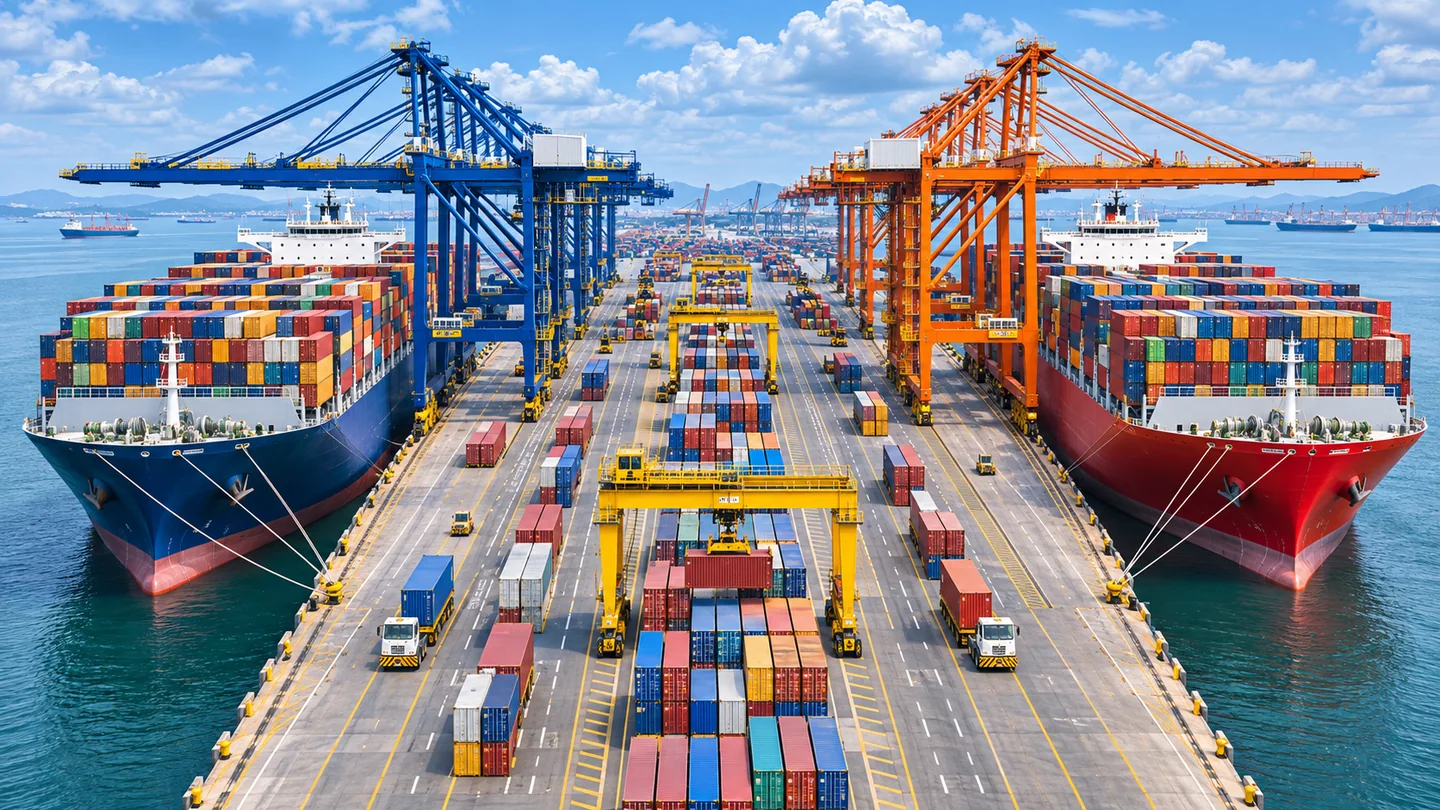
Will Maersk’s 12 new megaships lower container freight rates?
Not now, and not necessarily once they arrive. Maersk confirmed the order to Reuters ↗ on November 24. The 12 ships are designed to carry 24,000 twenty-foot equivalent units (TEU) each, with deliveries scheduled for 2030 and 2031. That totals 288,000 TEU of nominal vessel capacity, not 288,000 extra bookable slots a week.
Why ship size does not tell you what you can book
The dual-fuel ships are expected to be the largest in Maersk’s fleet. For competitive context, MSC described one of its own vessels ↗ in 2023 as capable of carrying up to 24,346 TEU. That was a separate vessel and is not part of Maersk’s order. What matters to shippers is where they sail and what they replace. A company can introduce larger vessels and retire, redeploy or idle existing tonnage. A port also has to handle bigger exchanges and the downstream movement of boxes. The order alone does not confirm trade-lane deployments, net additions, terminal calls or future price changes.
Freight impact: a long-term procurement signal
Larger ships can lower shipboard cost per unit if well utilized. Those economics may not flow through to a specific contract, and a larger call can put more pressure on a terminal or inland network at once. Ocean capacity is the direct exposure; ports, rail and intermodal services are potential downstream exposures. Do not model a near-term rate reduction from this order.
Put a service-level test in the next bid
Ask each shortlisted carrier to state its committed weekly allotment, planned rotation, recovery options and historical allotment fulfillment. Compare those promises on the same lane and frequency, not companywide fleet totals.
Fictional service comparison: A weekly string moving from an 18,000-TEU ship to a 24,000-TEU ship adds 6,000 nominal TEU per sailing, not per customer. If it drops a call at your origin, your direct booking options can shrink despite the larger ship. Ask for the minimum committed weekly slots on your lane and a written replacement path before relying on fleet totals.
Frequently asked questions
What does TEU mean?
A twenty-foot equivalent unit is a standard capacity measure. One forty-foot container generally represents two TEU.
When are the 12 Maersk megaships expected?
Deliveries are planned for 2030 and 2031. The order is not an immediate injection of capacity.
Did Maersk confirm more than 12 ships in this order?
Reuters reported company confirmation of 12. The reported possibility of a larger order is not part of that confirmation.
Editorial note
SCS Research editorial method ↗. Hypothetical costs are not quotes or realized savings.
Owner-authorized November 24 editorial release; sourced reporting, custom illustration and original conditional shipper decision aid.
Sources & publication notes
Reported facts remain attributed; hypothetical costs are not quotes and do not establish actual freight charges.
- Reuters with Maersk statement and spokesperson confirmation ↗Checked November 24, 2026 · November 24; order count, nominal capacity and planned delivery years
- MSC vessel announcement ↗Checked November 24, 2026 · July 2023; historical fleet comparison, not part of the new order
SCS publication: 24 Nov 2026 · 12:51 UTC. Last modified: 24 Nov 2026. Research cutoff: November 24, 2026 Pacific morning source review; not the publication time. Source dates are distinct from publication. Reported figures remain attributed, not independently audited. External source availability may vary.
AI-assisted source checking and original SCS analysis. No separate human factual review is recorded.
Use your own evidence.
Compare freight offers ↗ — Compare equivalent service, rate scope and shipment assumptions.
Tools remain separate from the reporting. No headline becomes a live quote, a guaranteed saving or an automatic surcharge.