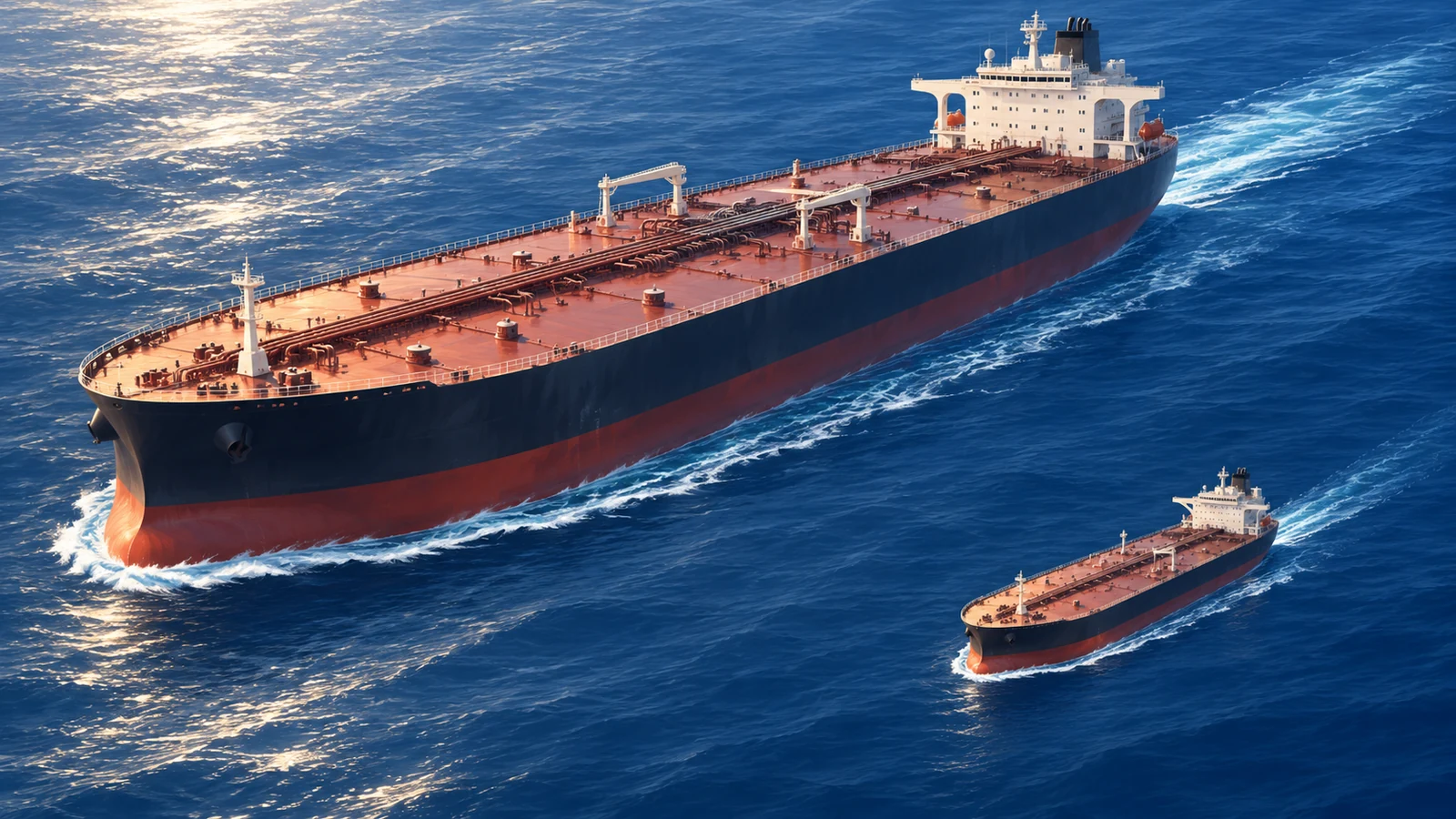
Are smaller tankers automatically cheaper per barrel?
No. A lower headline charter quote can cost more per delivered barrel when a ship carries less cargo or requires a second movement. Compare matched written quotes, loadable quantities and confirmed delivery schedules before changing vessel class.
What did the October data show?
A November 19 report published by Moneycontrol under a Reuters byline cites Vortexa data showing that Suezmax and Aframax tankers carried more than 1 million barrels a day through the Strait of Hormuz in October. This is a reported monthly rate of flow, not an increase of 1 million barrels a day. The same report gives 10.3 million barrels a day for overall exports in its October series and notes that figures may be revised. The underlying analytics dataset was not independently accessed. November 19 syndicated reporting ↗
The report cites brokers who assessed a Persian Gulf–China Suezmax rate at roughly one-third to just under one-half of a published very large crude carrier benchmark for the route. The published comparison does not establish a common cost basis, identical cargo quantities or the same included items. It is not an executable quote or proof of per-barrel savings. Broker comparison as reported November 19 ↗
The separately reported ADNOC vessel incident remains covered in the existing incident briefing ↗. A different vessel class is not a safety guarantee; this article evaluates commercial quote comparability, not a route-safety recommendation.
Decision aid: Divide comparable total costs by usable delivered barrels
For each viable option, obtain the loadable quantity, receiving compatibility and delivery window. Put both quotes in the same currency and cost basis, then include any documented buyer-paid insurance, port, handling or extra voyage costs without double counting. If one vessel cannot cover the order, price the remaining barrels and check the complete schedule. Confirm acceptance and coverage in writing before committing.
In a fictional 1.6-million-barrel order, suppose one larger voyage can deliver the full amount for $4.0 million, or $2.50 a barrel. Two smaller voyages can each carry 800,000 barrels and cost $1.8 million each. With no extra costs they total $3.6 million, a $400,000 advantage. But if the combined incremental handling and buyer-paid voyage costs amount to $500,000, the smaller option costs $4.1 million, about $2.56 per delivered barrel. An unconfirmed second sailing or a missed delivery window would make it a different service regardless of arithmetic. These are invented numbers, not estimates of Hormuz rates.
Frequently asked questions
Do the October figures mean Hormuz has returned to normal?
No. The estimate describes a month of movements, not the current availability, safety or insurance terms of a particular voyage.
Is the reported broker comparison a percentage saving for buyers?
No. It compares headline rates from the reporting; actual per-barrel costs depend on the usable quantity, contractual cost basis and delivered service.
Editorial note
SCS Research used AI-assisted sourcing and original analysis. October figures and the broker comparison remain attributed, not independently audited. No separate human factual review is recorded. Editorial method and corrections ↗
November 19 owner-authorized release. Original publication dates retained for updated stories; reported facts, conditional exposure and original decision aids remain distinct.
Sources & publication notes
Claim-level sources and uncertainty are identified in the copy. Reported figures remain attributed, not independently audited.
- November 19 syndicated reporting ↗Source dates identified in article; checked November 19, 2026 · Claim-specific attribution and limitations in article.
SCS publication: 19 Nov 2026 · 13:08 UTC. Last modified: 19 Nov 2026. Research cutoff: November 19, 2026 prepublication source check; individual observations remain dated; not the publication time. Source dates are distinct from publication. Reported figures remain attributed, not independently audited. External source availability may vary.
AI-assisted research and original analysis. Owner authorized publication; a separate human factual review is not recorded.
Use your own evidence.
Compare complete shipment costs ↗ — Use matched written offers and explicit assumptions.
Review freight costs and evidence ↗ — Use booking, invoice and contract evidence.
Tools remain separate from the reporting. No headline becomes a live quote, a guaranteed saving or an automatic surcharge.