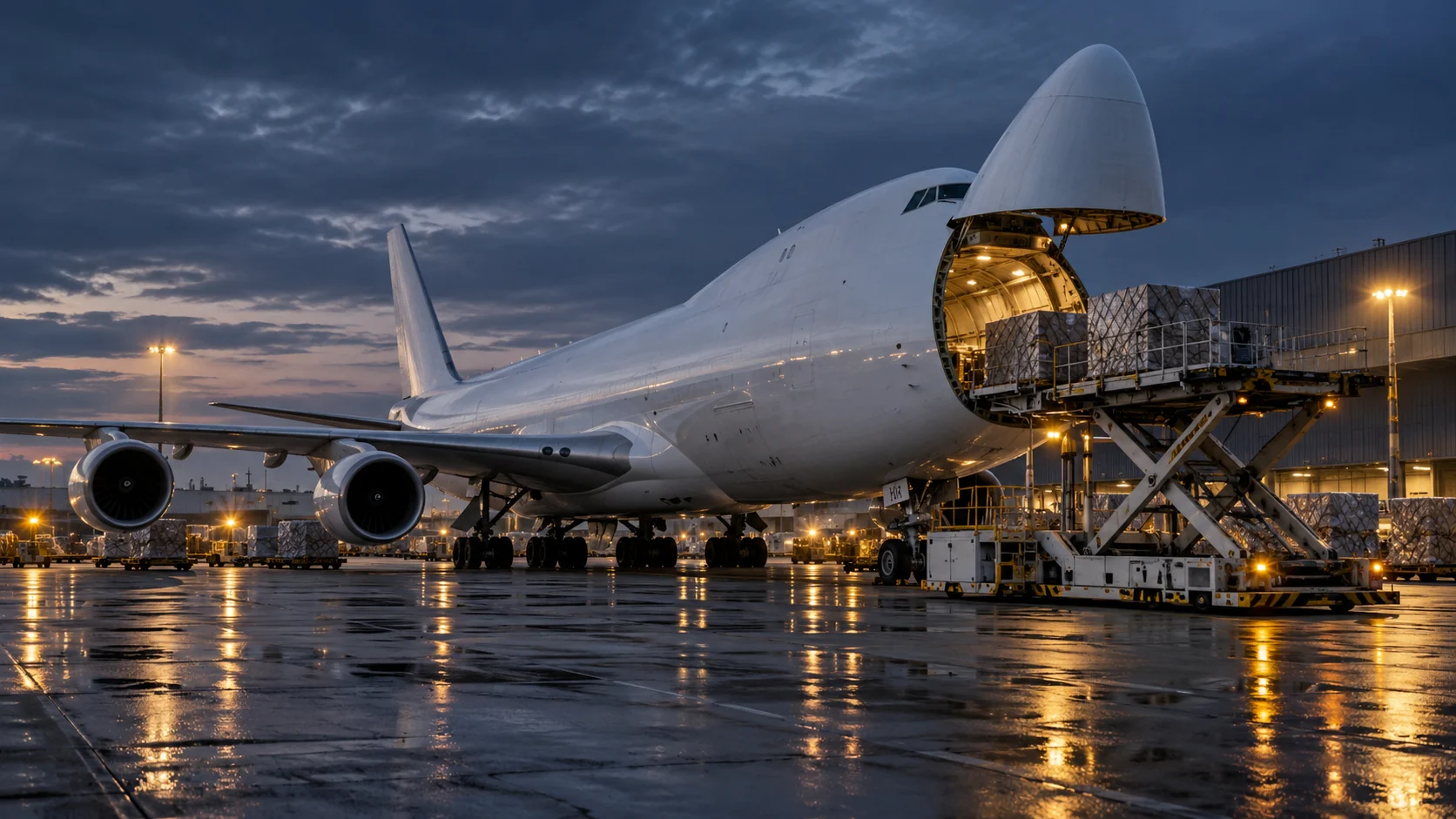
Partial reopening is an operational update, not a guarantee that a booked cargo movement can proceed.
Saudi Arabia reports a partial Riyadh airport reopening amid renewed threats. Two terminals reopening does not establish normal cargo service or lower freight costs.
What happened?
Reuters reported Cirium’s tally: Riyadh cancelled 4,071 of 4,736 scheduled flights (about 86%) during October 8–25. Across Saudi airports, more than 7,800 scheduled departures (45%) were cancelled in that window.
Reuters described a partial Sunday reopening: domestic services at Terminal 1 and national carriers’ international services at Terminal 2. Flight counts are not cargo tonnes or freight prices.
Reuters reported on October 25 that Saudi Arabia said King Khalid International Airport had partially resumed operations at two terminals after an October 10 halt. The announced arrangement assigns Terminal 1 to domestic flights and Terminal 2 to national carriers’ international flights.
The Saudi-led coalition said it intercepted missiles and drones. Its account included two drones and a ballistic missile toward Riyadh, a cruise missile toward Khamis Mushait, and ten ballistic missiles toward southern Saudi Arabia. These counts are attributed to the coalition, not an independent incident tally.
Reuters also reported renewed Houthi threats against the airport. The partial reopening is not confirmation that an individual flight, cargo booking or handling facility is available.
Delta’s October 12 company announcement postpones the planned Atlanta–Riyadh nonstop launch until March 2027. This is a launch delay, not a suspension of an already operating Delta route.
A Lufthansa Group notice updated October 13 says Lufthansa flights to Riyadh are suspended up to and including November 18, 2026. These carrier-specific limits do not establish an airport-wide closure through November.
Sources checked October 25, 2026. Reporting is distinguished from operational analysis; no new freight-rate effect established. October 26: Reuters reporting of Cirium checked; no direct cargo-tonnage or rate dataset. Historical window, not current daily cancellation rate No cargo tonnes or rates reported Do not equate flight count and cargo capacity Launch delay is not suspended existing capacity Suspension end is not guaranteed reopening No cargo tonnage or rate inferred
Who is exposed?
Shippers with bookings on the affected route should verify their own carrier, handling and ground-transport arrangements.
October 26 update: cancellation totals are not a cargo-capacity measure
The newly reported tally describes disruption over October 8–25; it is not the percentage of today’s flights cancelled. Retain the historical window wherever the figure appears. A cumulative statistic cannot establish the availability of a particular departure after reopening.
For a shipment, obtain written confirmation of booking acceptance, the actual operating flight, cargo cutoff and handling arrangements. Confirm onward delivery separately. A partial passenger reopening does not itself verify that a booked cargo connection, handling facility or onward movement is ready.
Use a shipment-specific recovery test
Assign a status to each shipment: accepted and confirmed, awaiting carrier confirmation, or requiring an alternative. Include the date and source of the confirmation so a changed schedule is visible. Prioritize according to actual customer deadlines and available inventory rather than the aggregate cancellation percentage.
Compare any offered alternative using a dated all-in quote and a confirmed route. No cargo-capacity percentage, freight-rate premium or universal recovery date can be derived from the Cirium totals in this report.
Does 86% mean 86% of cargo capacity disappeared?
No. It is the reported share of scheduled Riyadh flights cancelled October 8–25, not a measured cargo-capacity decline.
Does partial reopening mean my cargo can move?
Not automatically. Confirm acceptance and the actual flight and handling arrangements with the carrier or forwarder.
A terminal announcement is not a cargo acceptance notice.
Our operational reading is to separate three questions: Is the airport permitting the relevant service? Is the booked airline operating that flight? Has its cargo handler accepted this shipment? A positive answer to the first does not settle the other two. Passenger-terminal reopening cannot by itself establish freighter capacity, warehouse access or a cargo cutoff.
Before dispatching a truck to the airport, obtain written confirmation of the flight, receiving location, tender deadline and any commodity restrictions. For a shipment already tendered, ask where it is held, who has custody and which storage terms apply. Time-sensitive goods need a workable recovery plan, not simply a reissued itinerary.
Compare an alternative on delivered cost and timing.
A diversion may change airport handling, road distance, customs arrangements and the number of transfers. Compare the original booking with an actual alternative quotation using the same cargo dimensions, delivery deadline and service scope. Record cancellation costs and quote expiry separately.
This is a planning framework, not a recommendation that a particular route is safe. Aviation safety and operating decisions belong to the relevant authorities and carriers. The cited reports do not demonstrate a new airfreight rate increase or a new closure of a maritime chokepoint caused by today’s developments.
Does Riyadh’s reopening mean normal air-cargo operations have resumed?
No. The report concerns a partial airport reopening. Confirm the specific airline, flight and cargo handler before treating a shipment as accepted.
Have freight rates increased because of this reopening?
The sources do not establish a new freight-rate change caused by the October 25 development.
Airport reopening and airline return dates are separate
A partial airport reopening does not override an airline’s published suspension or a postponed route launch. Delta’s own announcement provides a March 2027 launch target, while Lufthansa’s notice retains a Riyadh suspension through November 18. Neither is a guaranteed operating flight for a particular shipment.
Confirm the carrier, operating date and booking acceptance before releasing freight to a warehouse. Where a route has not launched, do not describe its postponement as lost existing cargo capacity. If an alternative is offered, verify its actual cargo handling and onward arrangements rather than relying on passenger timetable availability.
Will Delta’s Atlanta–Riyadh route start in October 2026?
Delta’s October 12 statement delays the planned launch until March 2027.
Does reopening mean all foreign airlines have resumed Riyadh flights?
No. Carrier-specific restrictions remain; Lufthansa’s checked notice suspends Riyadh through November 18. Recheck the actual operating service before tendering cargo.
What could this mean for my costs?
An airport milestone does not establish usable capacity for a particular shipment. The calculator examines fictional bookable tonnes; real prices and acceptance need separate confirmation.
Make the exposure auditable.
For a purely fictional shipment, an extra two days at an entered $400 per day would add $800 in the cost category being modeled. Do not treat that example as a tariff or put every delay charge into the same bucket. Record the payable storage, equipment or cancellation terms separately, and confirm which party bears them before changing a shipment plan.
The capacity table answers a different question: whether an assumed tonnage requirement fits available space. A shortfall is not a quote. It may require a smaller shipment, another departure or a different service, each of which needs its own acceptance and cost check. No safety determination is made by either calculation.
Does the entered shipment plan fit?
| Assumed capacity cut | Bookable space | Demand / available |
|---|---|---|
| 0% | 100 tonnes | 80.0% |
| 25% | 75 tonnes | 106.7% |
| 50% | 50 tonnes | 160.0% |
Values above 100% indicate a shortfall in the entered scenario, not a predicted rate increase. Commodity acceptance, chargeable weight, handling and actual bookings remain separate.
First qualify the service. Then price it. Your local shipping profile can supply compatible inputs. It does not prove the event affects your operation, and it never changes the source facts. Incompatible modes keep separate examples.
What should I watch?
- Carrier-specific operation and cargo acceptance notices.
- Revised tender deadlines, warehouse access and shipment custody.
- Actual alternative-route quotations and insurance conditions.
Bring these questions to your next review.
- Confirm flight operation and cargo acceptance in writing.
- Check storage and cancellation exposure before changing a booking.
- Keep hypothetical disruption costs separate from confirmed invoices.
Partial reopening is an operational update, not a guarantee that a booked cargo movement can proceed.
What changed in this coverage?
Source checked: 26 Oct 2026. This is a recorded research snapshot, not continuous monitoring. Reporting, editorial updates and hypothetical assumptions are distinct.
- SCS RESEARCH / ORIGINAL ANALYSIS
Added dated reporting and operating analysis, with service acceptance and hypothetical inputs kept separate from an airport announcement.
- DATED UPDATE / ORIGINAL URL RETAINED
Added Reuters-reported Cirium cancellation totals for 8–25 October and a shipment-specific recovery checklist. Original October 25 publication and hypothetical capacity inputs are preserved.
- MERGED SAME-DAY SOURCE UPDATE
Added verified detail from the corrected second research batch without creating a duplicate article URL.
Source-deployed article in this reader collection. This record is not a D1 editorial approval or an automated daily intake receipt. Later owner-released corrections or retractions take precedence at this URL.
FOLLOW THE CONNECTED COVERAGE ↗Sources & provenance.
- Reuters via Investing.com: Saudi flight disruption ↗October 26, 2026; host shows 06:26 AM without explicit timezone · Reuters reporting of Cirium totals; search-returned text
- Reuters via StreetInsider: Saudi flight disruption ↗October 26, 2026 · Search-returned full text; direct open inaccessible; same Reuters story, not independent corroboration
- Reuters: partial Riyadh reopening and renewed threats ↗25 October 2026 · Reuters syndication; airport announcement and threats attributed.
- Reuters: coalition reports missile and drone interceptions ↗25 October 2026, 17:52 Philippines time · Coalition-attributed interception report; not independent verification of every weapon.
- Delta: planned Riyadh flight delayed ↗October 12, 2026, 10:00 AM (page does not state timezone) · Primary carrier announcement directly opened; March 2027 planned launch
- Lufthansa Group: Middle East operating update ↗Updated October 13, 2026 · Primary airline page directly opened; confirms Riyadh suspension through November 18 notwithstanding optimistic page title
Article update. Updated October 26 with historical flight cancellations. First published October 25. The cancellation share is not a measured cargo-capacity reduction or a present-day cancellation rate.
Research edition: 26 Oct 2026 Pacific. First published: 25 Oct 2026. Last modified: 26 Oct 2026. Source periods and access limits appear above. Research-checked and source-deployed at the owner’s request. A separate human editorial review has not been recorded. This is not an automated publishing or D1 approval receipt. Reported figures are attributed to the source, not independently audited. External links open the original source; availability may vary.